Thursday, 16 March 2017

Practice questions! Exclusive discount!

Hello all you lovely revision gurus,

I hope exam prep is going well for everyone this year AND youre not getting too stressed out!

I wanted to let everyone know about a unique opportunity for a 20% discount for hannahhelp users for the revision site https://www.savemyexams.co.uk/

CODE: han20

This site has a tonne of resources for you to revise from: not only does it provide all the past papers in one place but has additional mock papers on top of that so you can take your revision even further! They've divided up all their material into managebale topic-based chunks as well, which you know I'm a fan of.


I could not get my hands on enough practice questions when I was doing my revision and would have been all over this site!

Apparently it's not just me who thinks past papers are a good idea, but, according to this researcher, studies show that practising past papers is the one thing all top students have in common!


So that's my little good luck gift to you all, use it wisely and stay clam!

Happy to have helped
Hannah x

Monday, 1 August 2016

Comments

Hi!

Please feel free to comment- extra information, corrections, helpful links and feedback are always welcome. But please be aware of how you phrase your comments; what you put out into the world is what you will receive from it. Negative energy on the internet harms the beauty of life and it's so sad that people should be fighting each other at such an important time for your futures.

 I appreciate all of you who stick up for me, it really does mean a lot, but I recommend not being aggressive to trolls as it only makes them stronger.

Apologies for anyone who has to read offensive comments, but unfortunately I don't keep up with my comments apart from corrections and legitimate queries so I don't delete or respond to unhelpful negative comments.

If you have commented honestly and someone has sent you an unpleasant reply, please know that they only represent their own view and if you were just trying to do or say something helpful or kind that most people will respect what you have said (but you will unfortunately tend to only get a certain type of person reply).

I really hope that no one with something helpful or kind to say is put off of commenting, because something I love about this blog is the way that everyone comes together to help each other out. Your greatest tool in an Internet conflict situation is that you don't need to read something if it is unpleasant and not designed to be helpful.

With that out of the way, thank you to everyone who helped this year (both with info and positivity), and I hope you get the results that you wanted. And welcome/welcome back to anyone crusing the site this year.

Positivity and serenity to all,
Hannah Help o

Wednesday, 6 April 2016

Nepal and Ads

Hello all loyal friends and fresh new faces,

I hope that you are keeping zen about your upcoming exams- I'm here for ya.

Since January have been in Nepal! Volunteering with Restless Development helping to improve livelyhoods and employment prospects in poverty stricken communities- check out my pics for a revision brake or give a little donation if you can (even a couple of quid goes a long way).

It was an amazing experience and our work benefited so many people! Unfortunately though, there was nooooo wifi what so ever (I know), so I haven't made any adjustments in a while.

So whilst I'm doing this keep an eye out for any helpful points in the comments (thank you so much for everyone who takes the time to comment feedback and corrections, keeping hannahhelp alive).

One more point, which is that I am going to put some ads on the blog.

Though this may be controversial I hope y'all understand: I am trying to get together money for a plane flight to Africa so that I can volunteer there with a charity working to prevent the spread of AIDs in the young population.

Do let me know if you think they are obtrusive or affecting your revision, because I can always take them down, but if not it's a win win- you're getting hannahhelp and I'm getting p ;)

Remember to work hard and relax hard- no slacking, no stressing. Ok?
Best of luck,
Hannah x

Monday, 24 August 2015

Thanks

Hello all,

I just wanted to say a massive massive thank you to everyone who has commented on my blog over the years.

I've just tried to filter through some of the comments to make final corrections, as I have finished my schooling career so probably won't revisit hannahhelp to make edits in the future, and it has reminded me how lovely you all are.

People have written me the nicest praises and thanks that you could imagine and I am so grateful- I am just sorry that I can't reply to them all individually any more because there are so many! Just know that your words have touched me and I am thankful.

Corrections have been so helpful too as firstly (as you probably know) I can't really spell haha and secondly they have ironed out mistakes that I made. People have also added links and extra information, which has turned this from my blog into an even richer resource, acting as a hub for knowledge.

One of the best things that I have seen is people asking questions and other readers answering them! Asking questions gives an opportunity for clarification, not just for the person who asked but for everyone reading; and people who have given answers I commend you for giving your time to help me and everyone else.

I really hope that this culture of adding, debating and aiding continues even after I completely stop editing :')

Thank you all so much.
Happy to have helped ;)
Hannah.

Wednesday, 30 April 2014

Apology

Thank you guys for all your comments that are coming in, I really do appreciate it.

Unfortunately I am also doing exams at the moment and there just isn't time to reply to them all.

I promise I will amend and converse as soon as I have the time!

Best of luck for your GCSEs!

Hannah :)

Friday, 3 January 2014

2.90 understand the sources, roles and effects of the following hormones: ADH, adrenaline, insulin, testosterone, progesterone and oestrogen.

ADH
Lack of water is detected by the hypothalamus in the brain, it causes the pituitary gland to produce Anti-diuretic hormone, or ADH. This makes the kidneys to reabsorb more water- so less is lost from the body.

Adrenaline
Produced in the adrenal glands in stressful situations. Heart rate quickens to increase the flow of blood to muscles- this means that they can respire more (as there is more oxygen available) to provide energy if you need to 'fight or flee'.

Insulin
Produced in the pancreas when there is too much glucose in the blood. It stimulates cells to convert the glucose into glycogen which is a from that can be stored. This means that you always have the right amount of glucose in your blood.

Testosterone
Produced in ovaries in girls and testicles in boys. Plays a key role in puberty, developing sex organs and inspiring hair growth.

Progesterone
Produced in the ovaries it maintains the lining ready for pregnancy, and continues to do so if the egg is fertilised.

Oestrogen
Produced in the ovaries, it is controls other hormones to regulate the menstrual cycle. It stops the production of FSH and starts the production of LH.

Monday, 20 May 2013

3.33 understand that the incidence of mutations can be increased by exposure to ionising radiation (for example gamma rays, X-rays and ultraviolet rays) and some chemical mutagens (for example chemicals in tobacco).

There are things that make you more likely to have a mutated gene, these include: ionising radiation and chemical mutagens like some chemicals in tobacco.

3.32 understand that resistance to antibiotics can increase in bacterial populations, and appreciate how such an increase can lead to infections being difficult to control

Bacteria experience mutations (the reproduce very frequently so it is not rare.) These mutations can mean that they are no longer affected by a certain antibiotic, this makes it easier for them to survive. If bacteria evolve to be resistant to drugs we are treating them with then they are difficult to control; sometimes they can be stopped using a different antibiotic, but some are becoming resistant to all the drugs that we know of...

3.31 understand that many mutations are harmful but some are neutral and a few are beneficial

A lot of mutations are harmful, like genetic diseases; cystic fibrosis.
Some don't change the chances of survival: like having a different colour hair.
There are a few mutations which are beneficial, for example a insect pollinated plant becoming brighter.

3.30 describe the process of evolution by means of natural selection

Evolution is a change in species over a very long time (sometimes into different species.)
Natural selection is survival of the fittest.
What happens is:

  • A mutation occurs
  • If the mutation is beneficial, the animal will survive longer and reproduce more
  • Some of its offspring will inherit the mutation
  • These offspring will also have better chance of survival, meaning they live longer and reproduce more
  • Over a long period of time this process is repeated and gradually the mutation becomes a common gene in a species and those with the mutation become the only ones, as those without cannot compete with those expressing the mutated gene

3.29 understand that mutation is a rare, random change in genetic material that can be inherited

A mutation is when a gene is copied incorrectly, this gene can be passed down. It doesn't happen very often or on purpose.

3.28 understand that variation within a species can be genetic, environmental, or a combination of both

Variation in a species is the differences between the members of a species.
Genetic is caused by what genes are inhereted.
Environmental is caused by some action after birth (e.g the sun giving you a tan.)
Some variation is a bit of both...

3.27 know that in human cells the diploid number of chromosomes is 46 and the haploid number is 23

The diploid number is how many chromosomes each cell is meant to have: 46 in humans (23 pairs).
The haploid number is half of the diploid number: so 23.

3.26 understand that random fertilisation produces genetic variation of offspring

Because gametes contain a random selection of genetic information from each parent, the fertilised egg will be a mix of different genotypes which is why offspring are genetically different to their parents.

3.25 understand that division of a cell by meiosis produces four cells, each with half the number of chromosomes, and that this results in the formation of genetically different haploid gametes

Meiosis is when a cell splits in half, creating two copies, and then splits in half again to create four cells each with half the genetic information of a normal cell (haploid 23 chromosomes.)
This is how gametes are made.
bristol.k12.ct.us

3.24 understand that mitosis occurs during growth, repair, cloning and asexual reproduction

Mitosis cell division is the type that occurs in growth, repair cloning and asexual reproduction.

3.23 understand that division of a diploid cell by mitosis produces two cells which contain identical sets of chromosomes

Mitosis is when a cell replicates it self to make an identical copy.
A diploid cell is one with 23 pairs of chromosomes.
(you don't need to know the stage names, but its useful to know how mitosis happens.)

team6cell

3.22 describe the determination of the sex of offspring at fertilisation, using a genetic diagram

Genetic diagrams work the same as mono-hybrid inheritance diagrams: showing the mothers and fathers and then the different out comes. The only difference is, they will always be the same because one parent is always male and one parent is always female:
Gender determination

3.21 understand that the sex of a person is controlled by one pair of chromosomes, XX in a female and XY in a male

One pair of chromosomes (out of 23 pairs) controls the gender of a person. XX is female; XY is male.

3.20 predict probabilities of outcomes from monohybrid crosses

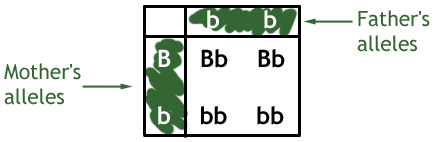
From mono-hybrid cross diagrams there are four outcomes, some times some of the out comes are the same.
To work out the probability of a child inheriting a genotype, you see how many times it comes up and divide it by 4 then times by 100 for a percent.
To work out phenotype probability you work out how many times they will express a characteristic and divide it by four then times by 100 for a percent.

If we say in this diagram the B represents brown hair and b represents red hair
(The capital letter is always dominant)

scienceaid

The likely hood of the chlid carrying one allele for brown and one for red (Bb) is two out of four:
2/4= 0.5
x100= 50%
The likely hood of the child having red hair (red hair is recessive so they both have to be red (bb)) is two out of four: also 50%